Understanding ECHA: A Holistic View on EU Chemical Compliance

15 Dec 2025
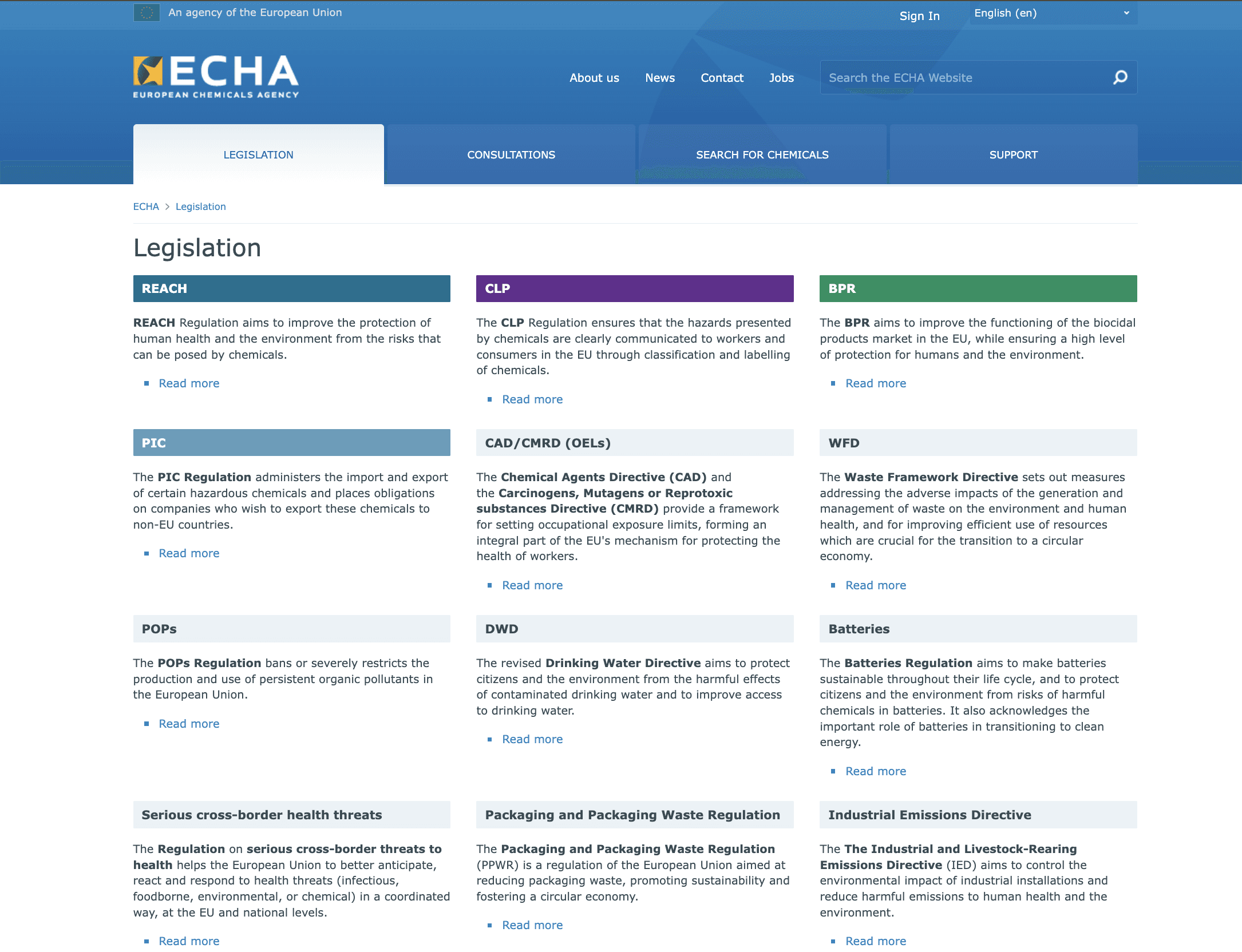
The European Chemicals Agency (ECHA) manages the EU's system for assessing and controlling chemical substances to protect human health and the environment. For companies operating in the EU, which regulations apply depends on their role in the supply chain. This article provides a holistic overview of ECHA legislation, categorized by two key functions: substance suppliers and article suppliers.
REACH Supply Chain Functions
Which of the 12 regulations defined by ECHA apply to a company depends on its function in the chemical supply chain. Like many other terms and concepts, the most fundamental definition of company functions is provided within REACH. Although other regulations contain some exceptions and minor adjustments, the REACH definitions largely apply across all legislation. REACH defines five formal supply chain actors:
Manufacturers produce or extract substances within the EU
Importers bring substances from outside into the EU
Only Representatives act on behalf of manufacturers outside the EU to fulfill their REACH obligations
Distributors store substances or mixtures and place them on the market unchanged
Downstream users use substances or mixtures in their operations (e.g., chemicals in cleaning services), formulate substances into mixtures, or use chemicals to manufacture articles
In reality, companies simultaneously hold multiple REACH functions. However, core business activities and regulatory obligations as supply chain actors focus primarily on whether the company's product is a substance (and mixture) or an article.
Suppliers of Substances
All EU companies working with chemical substances have obligations as substance supplier to some degree. The extent of substance-related obligations depends on the number and quantity of substances used and whether a substance/mixture or article emerges at the end of the production process. This group's primary responsibility is to register chemical substances circulating in the EU and conduct safety assessments. They must communicate hazard information and safe use recommendations both to regulatory authorities and throughout the supply chain via Safety Data Sheets (SDS) and exposure scenarios. From ECHA's regulatory perspective, they can be viewed as the entry point of the EU chemical supply chain. Therefore, their main obligation is to generate, research, and share fundamental information about chemicals.
Suppliers of Articles
Every manufacturer, importer, distributor, or other actor placing articles on the market—regardless of whether they manufactured it themselves or acquired it within or outside the EU—has article supplier obligations. Articles are objects where shape, surface, or design determines use to a greater extent than chemical composition (e.g., chair, phone, tire). Complex articles may consist of multiple levels of sub-articles, making determination of exact concentrations of contained substances extremely difficult. Assessing requirements related to substances contained in articles is a central challenge in supply chain communication. Therefore, article suppliers' obligations primarily relate to monitoring substance composition along their supply chain, reporting when certain substance concentrations are reached, and implementing safe use instructions. From ECHA's regulatory perspective, they can be viewed as the information-applying level in the supply chain. As such, they provide information about distribution, use patterns, and industrial dependency on specific chemicals.
ECHA Regulations and Their Scope
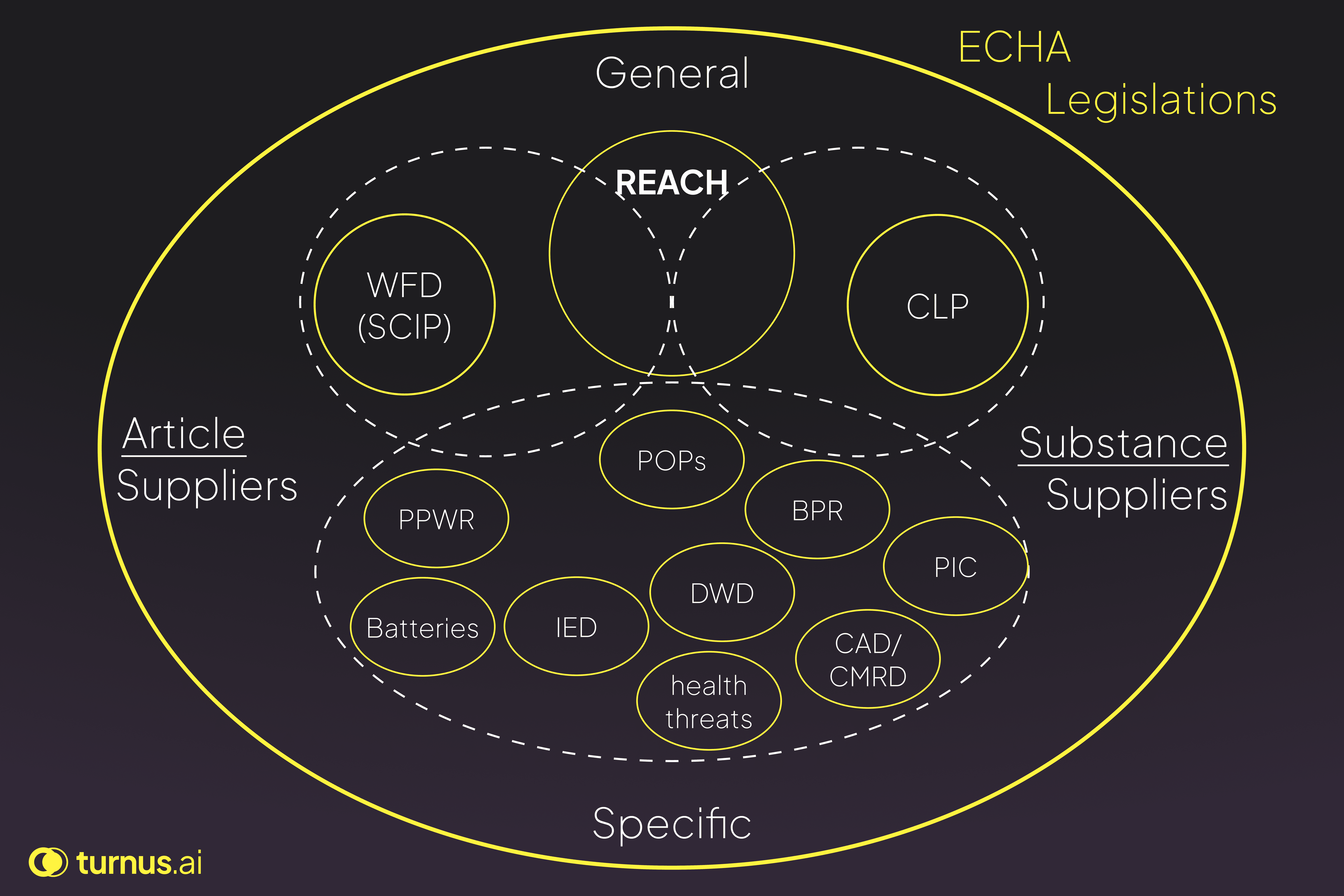
ECHA's regulatory framework comprises several regulations, each addressing different aspects of chemical management and different supply chain actors.
REACH: The Foundation for Product Compliance
REACH is ECHA's central and most comprehensive regulation. It establishes fundamental concepts and compliance workflows that underpin the entire regulatory system. REACH governs how substances manufactured or imported in the EU must be registered, continuously communicated through regulatory authorities and the supply chain, and defines the procedure for identifying and substituting hazardous substances.
Fundamentally, REACH applies to all chemical substances—not only those used in industrial processes but also in everyday products. Both substance suppliers and article suppliers have REACH obligations, but in different ways. Substance suppliers must register substances and conduct safety assessments, while article suppliers must notify when articles contain Substances of Very High Concern (SVHC) above threshold concentrations and communicate this information in the supply chain. Due to its broad reach, this regulation affects most companies operating in the EU.
CLP: Classification, Labelling and Packaging for Substance Suppliers
Alongside REACH stands the CLP Regulation, which defines how hazardous substances and mixtures placed on the EU market must be classified, labelled, and packaged. Since CLP applies to substances and mixtures, it primarily affects substance suppliers. Article suppliers are only subject to CLP requirements when their production processes involve handling chemical raw materials, making their obligations under this regulation dependent on the proportion of chemical substances in their business activities.
WFD: SCIP Database for Article Suppliers
Article suppliers' main obligation to monitor substance concentrations in their products derives from both REACH and the Waste Framework Directive (WFD). The WFD requires ECHA to maintain the SCIP database—a public registry of information about articles containing SVHCs. This database serves regulatory authorities, waste operators, and consumers by making the presence of hazardous substances in articles transparent throughout their entire lifecycle, including the waste phase. Since January 2021, producers, importers, and distributors of articles containing Candidate List substances above 0.1% weight by weight must submit detailed information to SCIP.
Specific Regulations for Substance Suppliers
Several targeted regulations apply primarily to substance suppliers:
Biocidal Products Regulation (BPR) – Regulates approval and use of biocidal active substances and products
POP Regulation – Prohibits or restricts highly persistent organic pollutants that remain in the environment and accumulate through food chains
PIC Regulation (Prior Informed Consent) – Regulates import and export of hazardous substances that are banned or severely restricted in the EU
CAD/CMRD – Establishes Occupational Exposure Limits (OELs) for workplace safety
Drinking Water Directive (DWD) – Requires substance assessments for materials in contact with drinking water
Industrial Emissions Directive (IED) – Controls emissions from industrial installations
Serious Cross-Border Health Threats – Enables ECHA to conduct risk assessments for public health when chemical-related threats occur
Specific Regulations for Article Suppliers
Article suppliers are subject to targeted regulations for specific product categories:
Battery Regulation – Establishes requirements for batteries and accumulators
Packaging and Packaging Waste Regulation (PPWR) – Establishes requirements for packaging materials
POP Regulation – May affect article suppliers depending on materials used in their products
About Us

Automate your compliance and sustainability questionnaires—swiftly, reliably, and AI-based directly from your data.
Follow us on
See also